AGI Publications
Selected publications
Full publication list at Google Scholar →
Working papers and preprints
October 2026Zenodo
Coordinate-Free Hidden-State Diagnostics Measure In-Context Meaning Override
Edward Y. Chang, Ethan Y. Chang
TL;DR: Measures when contextual examples override an established interpretation, separates leaving a prior from adopting its replacement, and develops coordinate-free hidden-state diagnostics that can reveal semantic movement before the final answer changes.
October 2026Zenodo
Literal Integrity Is Not Semantic Integrity: Descriptive Records Re-anchor Unchanged Commands
Edward Y. Chang, Ethan Y. Chang
TL;DR: Shows that non-imperative contextual records can change the operational meaning of an unchanged command, distinguishing literal and instruction integrity from semantic integrity and motivating authority-aware verification of the intended meaning.
September 2026Zenodo
Risk Bounds for Physical AI: Decision Ambiguity and Model Incompleteness
Edward Y. Chang
TL;DR: Distinguishes unavoidable risk within a valid model from unidentified risk under model escape, proves composed single-commitment risk bounds, and establishes on MetaDrive why detection screens and response choice dictate physical safety.
August 2026new
ALAS: Stateful Admission and Bounded Repair for Disruption-Aware LLM Workflows
Longling Geng, Jaylan Roy, Edward Y. Chang
TL;DR: ALAS is a runtime for agentic planning that admits, repairs and validates planning proposals with disruptions via bounded localized recovery.
Jul 2026ground-breaking
TRW: TRACE-RealWorld — An Auditable Consistency Contract for World Models as Materialized Views
Edward Y. Chang
TL;DR: Ensures consistency between the real world and the digital world: world state as a materialized view with typed commitment reads and auditable adaptive refresh.
Jul 2026new
TRACE: An Operational Reasoning Schema for Auditable Agentic Commitments
Edward Y. Chang and Emily J. Chang
TL;DR: A typed, versioned schema for reasoning records and one operating discipline: no durable state change without a record. Argues in three layers that reasoning is not in the language model.
Jun 2026new
Mnemosyne: Agentic Transaction Processing for Validating and Repairing AI-generated Workflows
Edward Y. Chang and Longling Geng
TL;DR: ATP treats all model actions as untrusted proposals under deterministic runtime admission; the open-source Mnemosyne runtime decouples committed-state correctness from the intelligence layer.
Jun 2026new
Architectural Wisdom: A Framework for Governing Optimization in AI Systems
Edward Y. Chang
TL;DR: A wisdom layer that constrains what an agent should optimize, restrain, and preserve. Foundational to
The Path to AGI, Volume 3.
May 2026new
Trivium: Temporal Regret as a First-Class Objective for Causal-Memory Controllers
Edward Y. Chang
TL;DR: Outcome-only correction captures only the what of failure; epistemic and temporal regret add the why and the when, yielding logarithmic delayed-identification regret over a persistent causal transaction log.
Mar–Apr 2026new
Exploring Collatz Dynamics with Human–LLM Collaboration
Edward Y. Chang
TL;DR: A conditional convergence framework reducing the conjecture to a single orbit equidistribution hypothesis, developed through a documented human–LLM collaboration whose failure modes are themselves analyzed.
Feb 2026new
Epistemic Regret Minimization: Label-Free Causal Critique Beyond Outcome Reward
Edward Y. Chang, Longling Geng
TL;DR: ERM critiques how LLMs reason causally, not just what they answer, catching shortcuts that outcome-only reward entrenches, without ground-truth labels.
arXiv 2025
UCCT: The Unified Cognitive Consciousness Theory for Language Models
Edward Y. Chang, Zeyneb N. Kaya, Ethan Chang
TL;DR: How LLMs turn pretrained capacity into goal-directed behavior via semantic anchoring: S = ρd − dr − log k, threshold-like performance flips, and ICL, retrieval, and fine-tuning unified as anchoring variants.
arXiv 2024
EVINCE: Optimizing Adversarial LLM Dialogues via Conditional Statistics and Information Theory
Edward Y. Chang
TL;DR: Information-theoretic metrics to optimize multi-agent debates, measuring when additional rounds yield diminishing returns.
Accepted publications, 2023–2026
Book 2026new
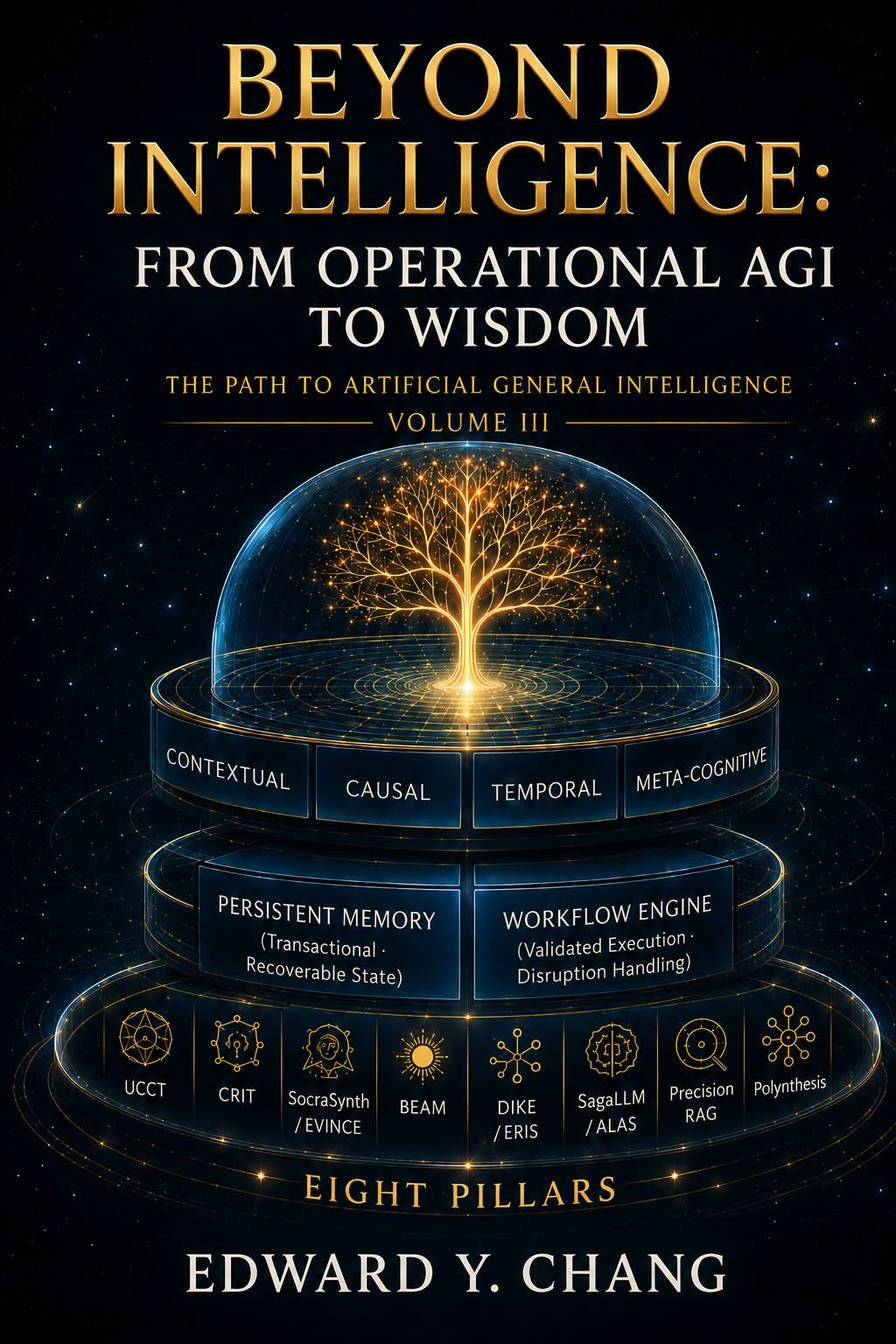
Beyond Intelligence: From Operational AGI to Wisdom (The Path to AGI, Vol. 3)
Edward Y. Chang
TL;DR: Memory you can trust, effects you can audit, and a wisdom layer that governs what is optimized, restrained, and preserved across long-horizon cognitive and physical agency.
ACM Books 2026new
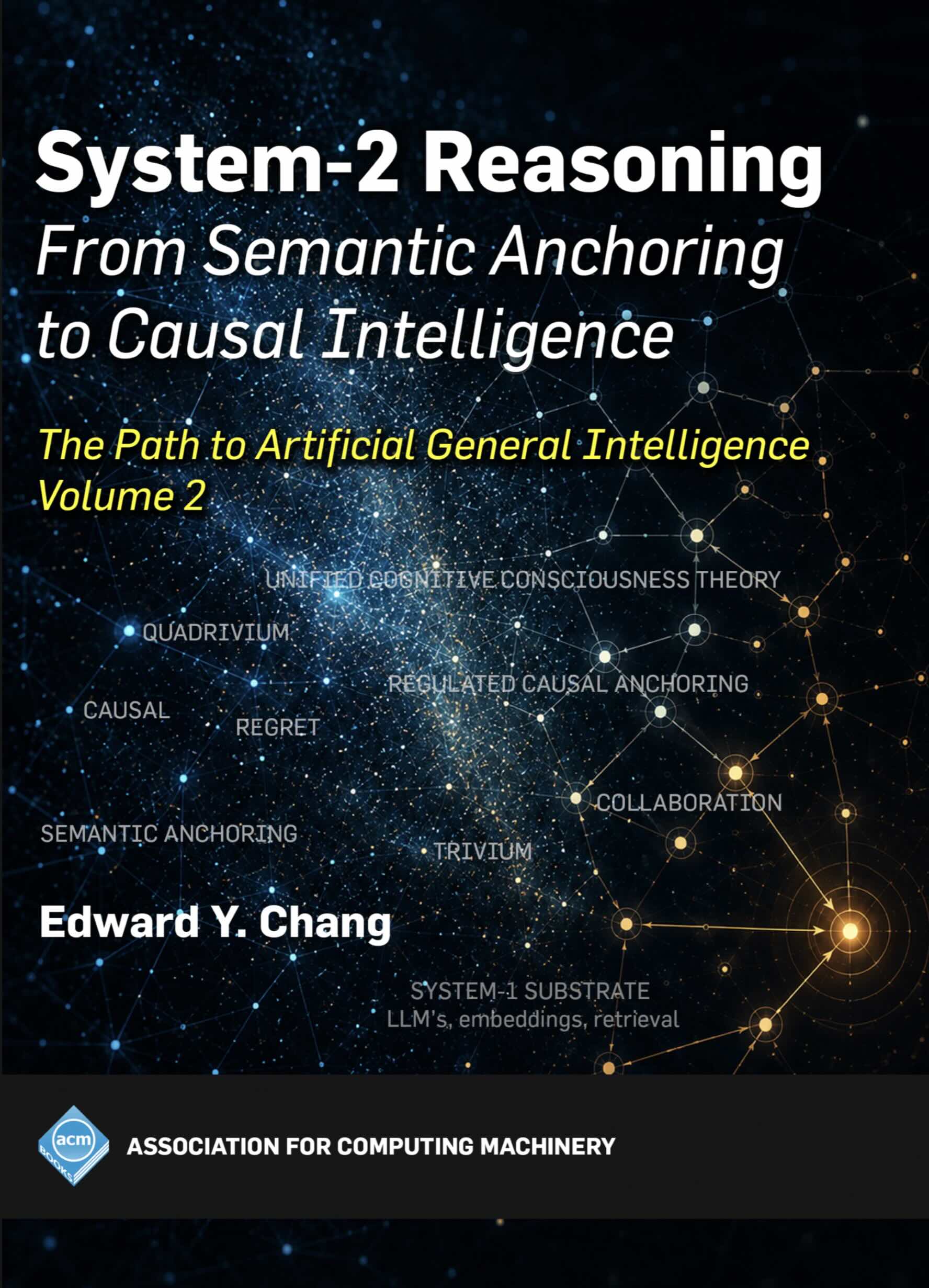
System-2 Reasoning: From Semantic Anchoring to Causal Intelligence (The Path to AGI, Vol. 2)
Edward Y. Chang
KDD 2026new
CausalT5K: Diagnosing and Informing Refusal for Trustworthy Causal Reasoning
Longling Geng, Andy Ouyang, Theodore Wu, Daphne Barretto, Matthew John Hayes, Rachael Cooper, Yuqiao Zeng, Sameer Vijay, Gia Ancone, Ankit Rai, Matthew Wolfman, Patrick Flanagan, Edward Y. Chang
TL;DR: A 5,000+ sample benchmark for causal reasoning: intervention queries, counterfactuals, sycophancy resistance, and Wise Refusal across ten domains.
KDD 2026new40+ citations
REALM-Bench: A Real-World Planning Benchmark for LLMs and Multi-Agent Systems
Longling Geng, Edward Y. Chang
TL;DR: Real-world planning tasks that expose the gap between LLM reasoning and practical deployment.
ICML 2026
AGI Requires a Coordination Layer on Top of Pattern Repositories (Position Track)
Edward Y. Chang
TL;DR: Critiques miss the bottleneck: pattern repositories are the necessary System-1 substrate; the missing component is System-2 coordination. An anchor paper of
Volume 1.
ACL 2026
Diagnosing and Mitigating Sycophancy and Skepticism in LLM Causal Judgment
Edward Y. Chang
TL;DR: The Skepticism Trap and the Scaling Paradox: larger LLMs regress into paralysis under causal ambiguity; CausalT3 and Recursive Causal Audit mitigate at inference time.
ACM Books 2025Top seller
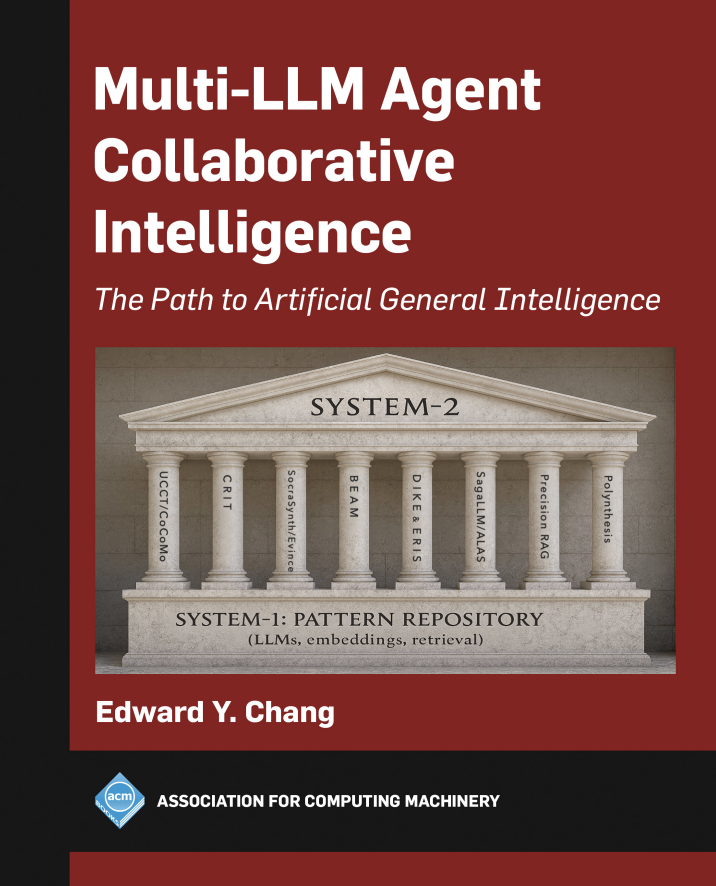
Multi-LLM Agent Collaborative Intelligence: The Path to AGI (Vol. 1)
Edward Y. Chang
VLDB 2025ground-breaking80+ citations
SagaLLM: Context Management, Validation, and Transaction Guarantees for Multi-Agent LLM Planning
Edward Y. Chang, Longling Geng
TL;DR: Database-style guarantees for multi-agent LLM planning: atomic, consistent, recoverable via compensating transactions.
ICML 2025
A Checks-and-Balances Framework for Ethical AI Alignment
Edward Y. Chang
TL;DR: A three-branch governance architecture (Executive, Legislative, Judicial) preventing unilateral harmful action.
NeurIPS SafeAI 2024
A Three-Branch Checks-and-Balances Framework for Context-Aware Ethical Alignment of LLMs
Edward Y. Chang
IEEE MIPR 2024
Behavioral Emotion Analysis Model for Large Language Models (invited)
Edward Y. Chang
IEEE CCWC 2023100+ citations
Prompting Large Language Models with the Socratic Method (CRIT)
Edward Y. Chang
IEEE CSCI 2023100+ citations
Examining GPT-4's Capabilities and Enhancement with SocraSynth
Edward Y. Chang